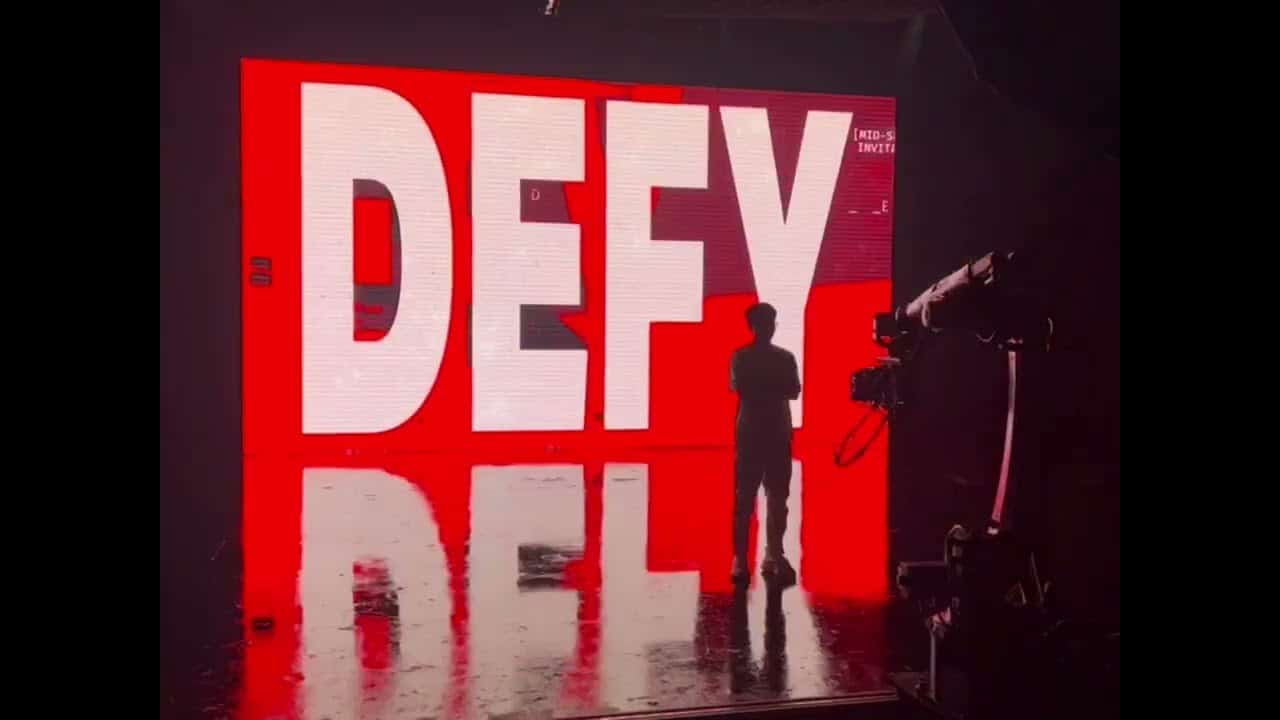
In 2023 Dynamo LED Displays built a 16:9 LED screen, 8 m wide by 4.5 m high at 2 mm pixel pitch, as the backdrop for e-gaming team DEFY’s promotional video. The wall came from our DVX Studio range, which is specified for camera work, so 4K content played behind the presenter instead of a built set.
Updated September 2026. Case study first published June 2023.
DEFY is an e-gaming team. For its promotional video it wanted the brand on screen behind the presenter, in camera, rather than added in post-production. Dynamo supplied a 2 mm pitch LED video wall built to a 16:9 canvas, and the production team lit and shot against it. The finished film is on our YouTube channel and embedded below.
Project summary
| Item | Detail |
|---|---|
| Client | DEFY, e-gaming team |
| Use | Backdrop for a promotional video shoot |
| Screen size | 8 m wide × 4.5 m high (16:9) |
| Pixel pitch | 2 mm |
| Product range | DVX Studio, Dynamo’s camera-optimised LED range |
| Content | 4K, 16:9 brand graphics and video |
| Year | 2023 |
| Supplied by | Dynamo LED Displays, London |
Why a 16:9 LED video wall for a promotional video
16:9 is the aspect ratio of almost every video deliverable. Broadcast, YouTube and social video are mastered at 16:9, and 4K UHD is 3,840 × 2,160 pixels, a 16:9 frame, as defined in ITU-R BT.2020. Building the wall to the same ratio means a 4K master fills the screen edge to edge with no letterboxing, no cropping and no black bars showing behind the presenter. At 8 m × 4.5 m the DEFY wall is exactly 16:9, because 8 divided by 4.5 equals 16 divided by 9.
Shooting against an LED wall changes what a promotional shoot can do:
- The scene changes with the content. A brand card, a colour wash and a full-screen video are the same wall a few seconds apart, with no set changes between takes.
- The camera sees the finished shot. The visuals are on screen during the take, so the presenter can react to them and the light they throw on the presenter is real, which is hard to fake with a green screen in post-production.
- One location. The whole video was shot in one place against one wall, which saves crew time and keeps continuity simple.
What makes a 2 mm LED screen work on camera
Pixel pitch and camera distance
Pixel pitch is the distance between the centres of two neighbouring LEDs. On camera it matters more than it does to the eye, because the camera sensor is also a grid, and two grids interfere. That interference is moiré. The closer the camera is to the screen, and the longer the lens, the finer the pitch needs to be for the LED grid to sit below what the sensor can resolve. For DEFY the wall was 2 mm, fine enough for a presenter standing directly in front of it. Our guide to fixing LED screen moiré on camera covers distance, focus and angle, and the LED viewing distance guide covers the numbers for the eye.
Refresh rate and frame rate
Flicker and rolling bands appear when the camera’s frame rate and the screen’s refresh rate are out of step. Two rules avoid it: run the screen at a high refresh rate, and choose a camera frame rate and shutter that divide cleanly into it. On multi-camera shoots the screen processor and the cameras are locked to a common timing reference, known as genlock, so every shutter opens at the same point in the refresh cycle. The DVX Studio range supports genlock, which is why we specify it for camera work rather than a standard events cabinet.
Content at 4K
“4K LED screen” describes the content the wall is built to show, not a fixed physical size. A wall’s pixel count is the number of cabinets multiplied by the pixels in each cabinet, and whether it reaches 3,840 × 2,160 depends on the pitch and the cabinet format, which our 4K LED video wall resolution guide works through. For a shoot, the practical rule is to master the content at 3,840 × 2,160, 16:9, and let the LED video processor map it to the wall’s native pixel count. Text and fine graphics should be built at final size and checked on the wall, through the camera, before the shoot day.
Other camera-facing LED walls from Dynamo
The DEFY shoot is one of several camera-facing walls we have supplied:
- Virtual production LED screen hire for TNT Sports: a Champions League advert shot on a hired LED wall, when the broadcaster was still BT Sport.
- Brook Sixth Form XR LED studio: permanent L-shaped 1.9 mm LED walls and an LED floor for a virtual production stage in East London.
- Broadcast studio LED backdrop design: our guide to specifying a studio backdrop that holds up on camera.
For a full stage rather than a single backdrop, see LED screens for XR and virtual production.
What the production team needs to provide
- Content masters at 3,840 × 2,160, 16:9, in a format the playback system can run, plus still frames for camera tests.
- A shooting plan: camera positions, lens choices and the nearest camera-to-screen distance, so pitch and refresh settings can be checked for moiré before the day.
- Frame rate and shutter for every camera, so the screen refresh can be matched, and a genlock reference if more than one camera is rolling.
- Floor space, power and access agreed in advance. An 8 m wall needs a clear run for the build and a lit set area in front of it.
4K LED screen backdrops: frequently asked questions
Is an 8 m × 4.5 m LED screen a 4K screen?
Not automatically. 4K UHD is 3,840 × 2,160 pixels, and a wall’s pixel count comes from its cabinets, not its size in metres. The DEFY wall, 8 m × 4.5 m at 2 mm pitch, was built to run 4K, 16:9 content, and its 16:9 shape means the frame fits without cropping. Our 4K LED video wall resolution guide shows the cabinet maths for any pitch.
What pixel pitch do you need to film an LED screen?
It depends on how close the camera gets and which lens it uses. The finer the pitch, the closer the camera can go before the LED grid shows as moiré. The DEFY wall was 2 mm, with the presenter standing directly in front of it. Wide shots from further back can tolerate a coarser pitch, and close-ups on long lenses need a finer one. Test with the production’s own cameras before committing.
How do you stop flicker and moiré when filming an LED wall?
Match the camera’s frame rate and shutter to the screen’s refresh rate so they divide cleanly, run a high refresh rate, and use genlock on multi-camera shoots so every camera and the screen share one timing reference. For moiré, increase the camera distance, soften focus so the screen sits behind the depth of field, or shift the shooting angle a few degrees. Record test footage and check it on a monitor, not by eye.
Can I hire a 4K LED screen for a promo video shoot?
Yes. Dynamo hires camera-ready LED walls for shoots, with a crew to build and commission the screen on site. Tell us the wall size, the content format and how close the cameras will get, and we will recommend a pitch and a refresh setting. See our virtual production LED screen hire case study and our LED screen hire page.
What is a 16:9 LED video wall?
A 16:9 LED video wall is built so its width is 16 units for every 9 units of height, the same shape as a 4K UHD or Full HD frame. The DEFY wall is 8 m × 4.5 m, and 8 divided by 4.5 equals 16 divided by 9, so standard video fills it edge to edge without letterboxing. Any cabinet count that keeps that ratio works, which is why 16:9 walls are the default for filming and presentations.
Planning a 4K LED screen for your next shoot?
Tell us the wall size you have in mind, the content you want to run and how the shoot will be filmed, and we will come back with a recommended pitch, a cabinet layout and a written quote.
Get a quote for a camera-ready LED screen. Contact Dynamo LED Displays or call 020 3489 9878.