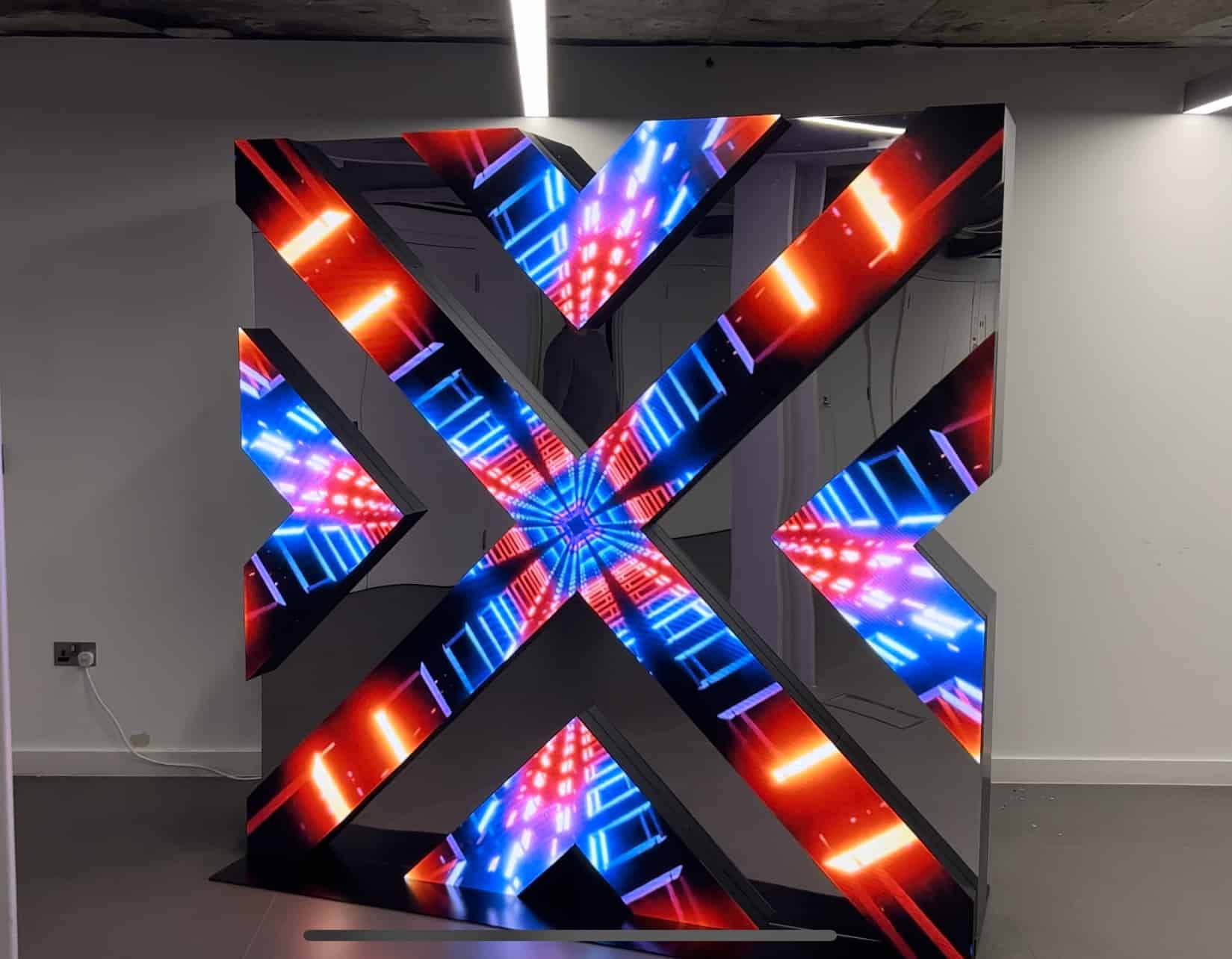
A custom LED display is a direct-view LED screen built to a shape or size that standard rectangular panels cannot make. For VMLY&R we reproduced the agency’s snowflake logo in its London headquarters lobby using triangular 2 mm pixel pitch LED modules, GOB resin protection and cloud-based asynchronous control. This case study explains how.
Updated September 2026: expanded with project facts, a build explanation, control-system detail, related custom builds and an FAQ. The original project description is kept.
The VMLY&R snowflake LED display
VMLY&R (now part of VML) is one of the largest advertising agencies in the world. Its London headquarters at Sea Containers on the South Bank needed something in the lobby that said who the agency was before anyone spoke. The brief was the logo itself: a snowflake, made of light, welcoming visitors and showing the agency’s work.
A rectangular screen with a snowflake graphic on it would have missed the point. The display had to be the shape. That is what puts a project in our custom LED displays category rather than the standard video wall one: the geometry is the product.
Project facts
| Item | Detail |
|---|---|
| Client | VMLY&R (now VML), advertising agency |
| Location | Lobby of the London headquarters, Sea Containers, South Bank |
| Shape | The agency’s snowflake logo |
| Modules | Triangular LED modules, arranged to form the points of the snowflake |
| Pixel pitch | 2 mm, a customised version of our DRE Series |
| Protection | GOB (glue on board) resin over every LED |
| Control | Asynchronous, cloud-based CMS with multi-user scheduling |
| Monitoring | Cloud diagnostics reporting temperature, signal source and system data |
| Scope | Design, engineering and installation by Dynamo LED Displays |
How a custom-shaped LED display is built
Triangular LED modules instead of rectangles
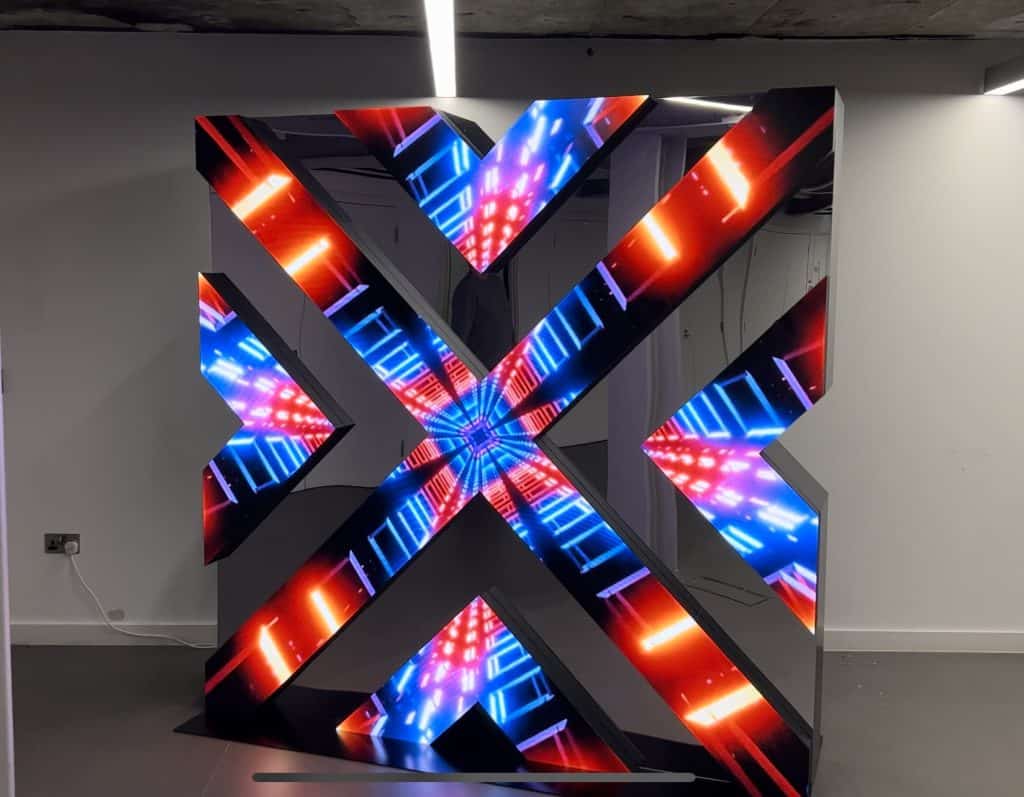
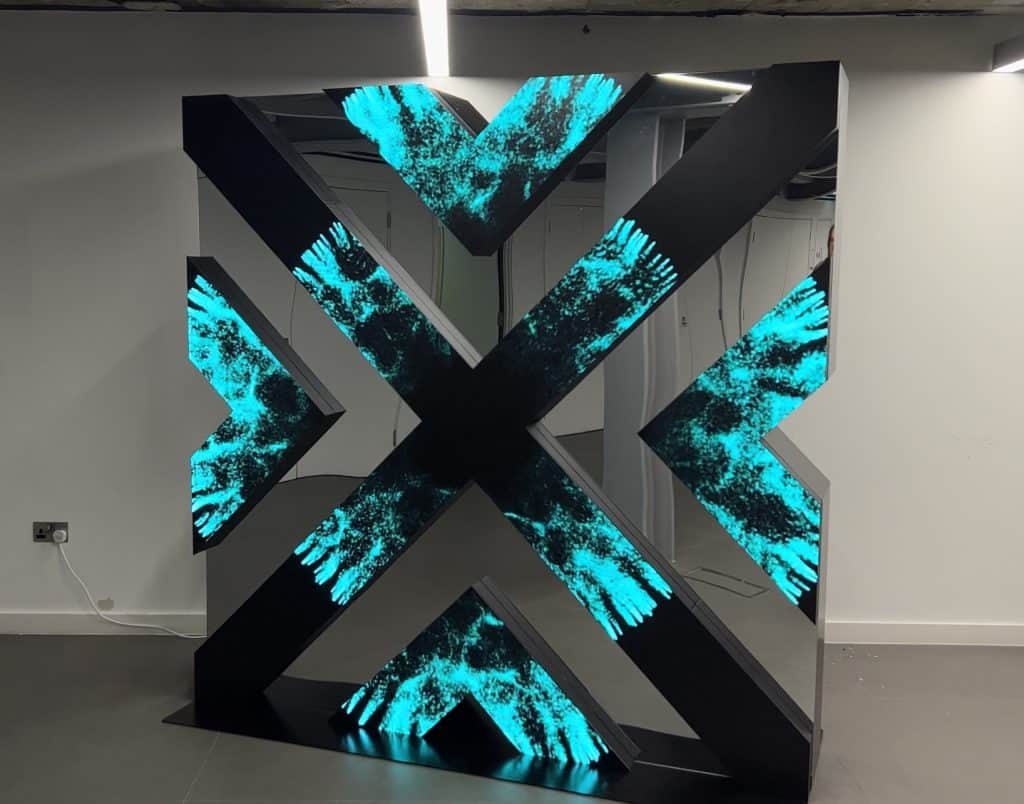
Nearly every LED screen is made from rectangular modules, which is why nearly every LED screen is a rectangle. A snowflake has six points and no right angles, so we built this one from triangular modules. Each triangle is a complete piece of LED surface. Arranged point to point, they trace the logo without the stepped, pixelated edge you get when you try to mask a rectangular panel into a shape.
The modules mount on a support structure made for the shape, and the whole assembly is mapped in the control system so that content plays across the triangles as one continuous image. For the content team, the snowflake behaves like a single screen with an unusual outline.
GOB protection for a lobby at hand height
A lobby display sits where people walk past, brush against it and touch it. Bare SMD LEDs are fragile: one knock can shear an LED off its pad. We used GOB (glue on board) LED modules, where a clear resin layer is set over the whole LED surface. It protects the diodes from impact, dust and moisture, and it can be wiped clean without damaging anything.
2 mm pixel pitch for close viewing
Pixel pitch is the distance between the centres of neighbouring pixels. At 2 mm the image holds together from a couple of metres away, which is how close people stand in a lobby. A coarser pitch would have shown visible dots up close; a finer pitch would have added cost for detail nobody would see. Our guide to LED display parameters explains how pitch, brightness and refresh rate interact.
Controlling the snowflake: cloud-based asynchronous playback
The display runs on an asynchronous control system, meaning the content is stored on a player at the screen rather than streamed live from a PC. The player is cloud-connected, so staff across the agency can log in, upload work and schedule it to play at set times without anyone standing in the lobby with a laptop. If you are weighing up the two approaches, read our guide to asynchronous and synchronous LED control systems.
The same connection carries cloud diagnostics. The system reports the hardware’s temperature, current signal source and other status data, so a fault can be spotted remotely before anyone in the building notices a problem.
Other custom LED displays we have built
The snowflake is one of several shaped or non-standard builds we have designed and installed in-house:
- The Dynamo LED cube for Lewis Hamilton’s Mission 44 event: a 2.8 metre cube with LED on every face, each face 428 × 428 pixels.
- Four recessed LED arches at 40 Leadenhall, set into the foyer walls of a City of London tower.
- The AutoTrader Manchester HQ installation: a 21.8 metre compound-curved LED ribbon halo plus an interactive display wall, installed on a live site.
Custom LED Displays: Frequently Asked Questions
What is a custom LED display?
A custom LED display is a direct-view LED screen made to a non-standard shape, size or mounting, rather than assembled from stock rectangular cabinets. That covers logo shapes like the VMLY&R snowflake, curves and ribbons, arches, cubes and screens recessed into architecture. The LED technology is the same; the module shape, support structure and content mapping are engineered for the specific brief.
What shapes can an LED screen be made in?
Rigid triangular, square and rectangular modules can be combined into most geometric outlines, including stars, hexagons, arches and cubes. Flexible LED modules handle curves, columns and waves. Truly organic shapes are built by choosing the smallest practical module and following the outline as closely as possible, then masking the edge. The tighter the curve, the smaller the module needs to be.
What pixel pitch does a custom-shaped LED display need?
The same rule as any LED screen: choose the pitch for the closest normal viewing distance. Lobby and reception displays viewed from one to three metres usually sit between about 1.5 mm and 2.5 mm; the snowflake used 2 mm. Shaped displays viewed from further away, such as a stage or atrium, can use a coarser pitch and save budget without any visible loss of quality.
How is content managed on a custom LED display?
Through a normal LED control system, with the shape mapped once during commissioning. The content team designs to a template that matches the outline, and the system plays it across the modules as one surface. On the snowflake we used a cloud-based asynchronous player, so authorised staff schedule content from a browser and the hardware reports its status back over the same connection.
How much does a custom LED display cost?
Cost is driven by the LED area, the pixel pitch, the module type and the fabrication work needed for the shape and support structure. Non-standard modules and bespoke frames add engineering time on top of the LED itself, so a shaped display costs more per square metre than a flat wall of the same pitch. Our LED display cost guide covers the main price drivers.
Can a custom LED display be used in a reception or lobby?
Yes, and lobbies are one of the most common settings. Use a fine pitch for close viewing, GOB-protected modules so the surface survives knocks and cleaning, and set the brightness for the ambient light so the display is vivid without glaring at people waiting nearby. An asynchronous player keeps it running reliably without a dedicated PC.
Get a quote for a custom LED display. Send us the shape, the location and the viewing distance through our contact page or call 020 3489 9878, and we will come back with module options, pitch recommendations and a price.