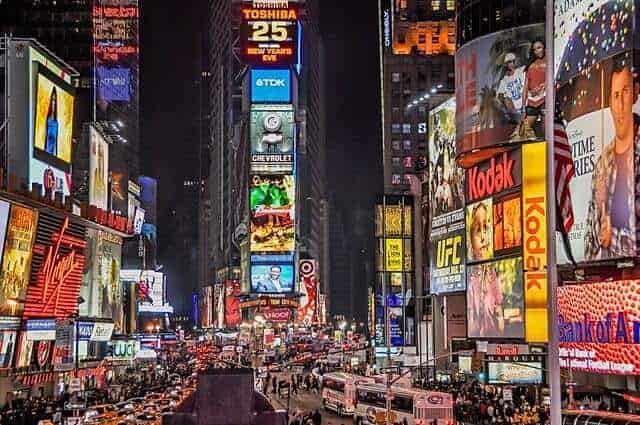
LED advertising uses direct-view LED screens, indoors or outdoors, to show static or video adverts that can be changed remotely in minutes. Its main benefits are brightness that works in daylight, no reprint costs, scheduled or live content, and measurable audience data. One screen or a networked estate of them runs from a single content management system.
Updated September 2026: restructured with a direct answer, a set-up checklist, UK planning consent notes, real Dynamo installations and an FAQ. The ten benefits from the original article are kept and tightened.
Key takeaways
- An LED advertising screen is a direct-view LED display: every pixel is a cluster of red, green and blue LEDs, so it stays readable in direct sunlight where a backlit poster or LCD washes out.
- The commercial case rests on four things: no print or reinstall cost per campaign, remote scheduling from a CMS, the ability to sell the same screen to several advertisers by time slot, and audience data you cannot get from paper.
- Pixel pitch follows viewing distance. Roadside and high-street screens typically run 3.9 to 10 mm; shop windows and indoor retail 1.8 to 3.9 mm.
- In England most illuminated digital advertisements need express advertisement consent from the local planning authority before they go live.
- Buy for a permanent location; hire for a campaign or event. The hardware is the same, the commercial model is not.
What is LED advertising?
LED advertising is out-of-home or in-store advertising shown on a direct-view LED screen rather than on print, a backlit light box or an LCD panel. The screen is built from LED modules mounted in cabinets, driven by a controller and fed by a media player or a cloud-based content management system. Content can be a static image, a video loop, a live data feed or a playlist that changes by time of day.
The format scales from a single window screen to the wrap-around canvases of Piccadilly Circus. Because the display surface is modular, an LED advertising screen can be built to almost any size and shape, including curves, columns and right-angled returns, which is not possible with LCD.
Sectors that use LED advertising screens regularly include:
- Shopping centres and high-street retail
- Restaurants, bars and hotels
- Cinemas, theatres and visitor attractions
- Universities, colleges and schools
- Airports, stations and transport hubs
- Stadiums, arenas and sports clubs
- Exhibitions and live events
Our LED displays guide covers the product families behind these installations in more depth.
The technology behind an LED advertising screen
Four components decide how an LED advertising screen performs. The LED modules set the pixel pitch and brightness. The cabinets set the physical size, weight and weather rating. The controller or processor maps the incoming video onto the exact pixel grid. The CMS or media player decides what plays, when, and on which screens.
Outdoor advertising screens need far more brightness than indoor ones. Our outdoor DFA Series datasheet, for example, rates the cabinets at 4,000 to 5,000 cd/m² with black-face LEDs and 6,000 to 8,000 cd/m² with white-face LEDs, with IP65 protection front and rear. Indoor retail screens run at a fraction of that and can use finer pitches because viewers stand closer.
Networking is what turns a screen into an advertising asset. Single or multiple screens are addressed from one CMS, so a campaign can be pushed to one site or a hundred, with proof-of-play logs recording exactly when each advert ran. Camera or sensor-based audience counting can be added where privacy rules allow.
Interactive and augmented-reality advertising
Because the screen is driven by software, it can react to people in front of it. Pepsi’s 2014 augmented-reality bus stop in London turned a digital panel into a fake window with tigers and UFOs appearing in the street behind it, and it remains one of the most shared out-of-home campaigns.
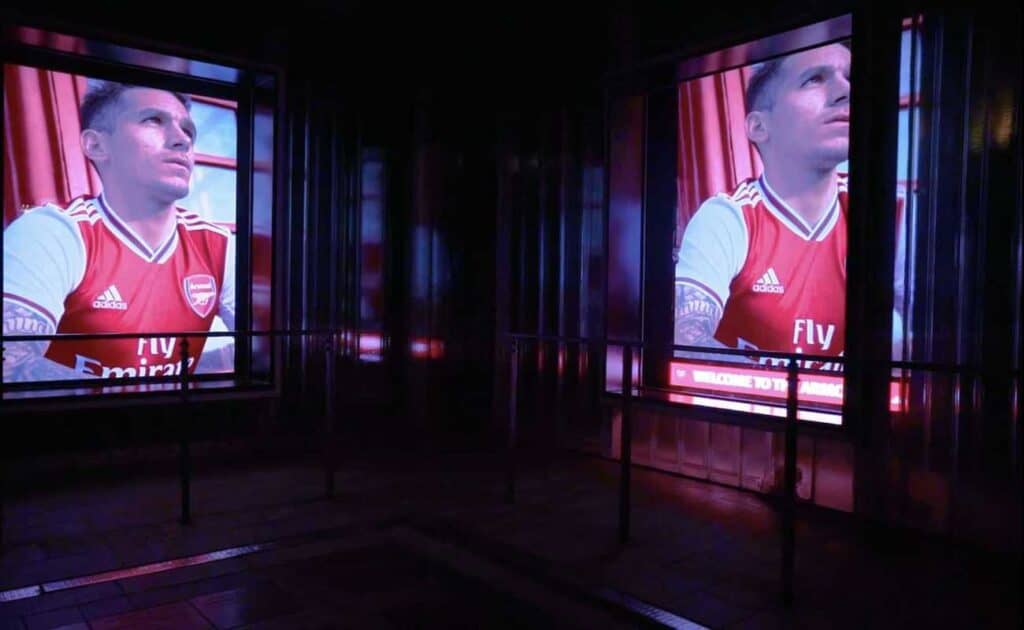
We have built the same idea at retail scale. At Arsenal FC’s Armoury store the augmented-reality skill zone runs on a 3 m × 1.5 m LED screen at 1.8 mm pitch, placing fans alongside players on screen with footage emailed to them for sharing. The mechanics of the technology are explained in what is augmented reality and how does it work.
10 benefits of LED screen advertising
- Sales uplift at the point of purchase. In-store screens put moving product content beside the shelf or the till and can be changed by store, by day-part or by stock level.
- Reach beyond your own footfall. An outdoor screen turns passing traffic and pedestrians into an audience. Reach depends on footfall, traffic speed and how long each message holds the screen.
- Daylight-readable image quality. Direct-view LED holds contrast in full sun, so the brand looks the same at noon as it does at night. Over time a consistently sharp presence builds recognition with regular passers-by.
- No reprint or reinstall costs. A campaign change is a file upload, not a print run and a rigger. Corrections and seasonal swaps cost nothing beyond the content itself.
- Synchronised multi-channel campaigns. The same creative can run on web, mobile, in-store and digital out-of-home at the same moment, all scheduled from one place.
- Real-time updates. Prices, countdowns, live scores, weather-triggered creative or news can be changed instantly from a browser, on one screen or an entire estate.
- Measurable audiences. Proof-of-play logs show exactly when each advert ran. Where permitted, sensors and cameras add dwell time and audience counts, so creative can be adjusted on evidence rather than instinct.
- Integration with other media. QR codes, NFC, EPOS data, touch screens and social feeds connect the screen to a purchase or a sign-up rather than leaving it as a poster.
- Low running cost. Once the hardware is installed, the ongoing costs are electricity, a CMS licence and routine maintenance. Screen time can be sold to several advertisers, which is why media owners treat screens as revenue-generating assets.
- Straightforward operation. Scheduling a playlist in a modern CMS takes minutes and needs no technical staff on site. The specialist work is in the specification and installation, not the day-to-day.
Setting up LED advertising: what to decide first
Most costly mistakes on LED advertising projects happen before any hardware is ordered. The table below lists the decisions that fix the specification.
| Decision | Why it matters | Typical answer |
|---|---|---|
| Location and viewing distance | Sets the pixel pitch and therefore most of the cost | Rule of thumb: minimum comfortable viewing distance in metres roughly equals the pitch in millimetres. Roadside 6 to 10 mm; high street 3.9 to 6 mm; shop window or indoor 1.8 to 3.9 mm |
| Indoor or outdoor | Brightness, weather sealing and structure | Outdoor: 5,000 cd/m² or more and IP65; indoor: far lower brightness, finer pitch |
| Planning consent | Illuminated adverts are regulated separately from planning permission for buildings | Apply for express advertisement consent before ordering; see below |
| Content and control | Decides the processor, media player and CMS | Cloud CMS for multi-site estates; local player for a single screen |
| Own or hire | Capital cost versus campaign cost | Buy for permanent sites; hire an LED screen for events and short campaigns |
| Support and warranty | Screens run all day, every day | Standard warranty on our fixed installations is 3-year return-to-base; agree spares and response times up front |
Planning consent for LED advertising screens in the UK
In England, advertisements are controlled under the Town and Country Planning (Control of Advertisements) (England) Regulations 2007. Some small signs have deemed consent, but an illuminated digital screen facing the public highway will almost always need express consent from the local planning authority, and councils look closely at brightness, animation and distraction to drivers. Our outdoor LED planning permission guide walks through the process and what councils ask for.
Advertising content itself is regulated by the CAP Code, administered by the Advertising Standards Authority, which applies to digital out-of-home exactly as it does to print.
Budgeting for an LED advertising screen
LED screens are priced per square metre, and pitch is the biggest single driver: halving the pitch roughly quadruples the LED count. Brightness, cabinet type, structure, power, data and installation access add to that. Our LED display cost guide sets out the price bands, and LED screen financing options covers lease and hire-purchase routes that spread the capital cost against advertising revenue.
Should you invest in LED screen advertising?
Digital out-of-home is now the growth end of the outdoor market. Outsmart, the UK out-of-home trade body, publishes the market figures, and Route provides the audience measurement that media buyers plan against. The major media owners have already converted their prime roadside, rail and shopping-centre sites to digital, so the remaining opportunity for a new entrant is usually local: a well-placed screen on a busy high street, a retail park or a venue you already control.
Both the screen and its location are assets. A permitted, powered site with proven footfall has value in its own right, and a screen on it can carry several advertisers a day. That is the basis of a local LED advertising business, or of adding screens to an existing signage or media company.
What an LED screen advertising business plan needs to cover
- Finding and securing a location with the footfall or traffic to sell.
- Advertisement consent from the local authority, and landlord agreement where the site is not yours.
- Indoor or outdoor, and the brightness, weather rating and structure that follow from it.
- Pixel pitch matched to the viewing distance, so you neither overspend nor look coarse.
- Hardware, processor, CMS, networking, power and installation costs.
- Running costs: electricity, connectivity, CMS licence, maintenance and insurance.
- The advertisers you will sell to, local or national, and the rate card and slot lengths that make the site pay.
- A sales pipeline for filling the schedule, and creative guidelines so adverts read at the screen’s viewing distance.
- Scheduling software that handles proof-of-play reporting for advertisers.
LED advertising screens we have installed

The projects below show the range of LED advertising work we specify and install, from airport experiential to shop windows.
- Dubai International Airport, Terminal 3 arrivals: 169 m² of 2.5 mm pitch LED across ten structures, including flexible curved P2.5 halo screens wrapped 360° around columns, carrying Expo 2020 messaging to arriving passengers.
- Lift 109 at Battersea Power Station: four LED displays including a 3.5 m × 6 m LED billboard and a 5 m × 1 m wall-mounted display for lift times and pricing, on our DVX series at 3.9 mm pitch.
- Arsenal FC’s Armoury store: six external-facing 2 m × 2.5 m portrait window screens at 3.9 mm pitch and 4,500 cd/m², bright enough to read in direct sunlight, plus internal 2.5 mm screens and a custom LED ticker.
- A structural LED shop front at London Gatwick: a 6.7 m wide, 3.9 m tall LED arch at 3 mm pitch with right-angled return modules made in-house, forming the whole shop front of an airside boutique.
Window-facing retail screens are their own discipline, covered in window advertising with LED screens. For building-scale advertising surfaces, see LED billboards.
LED Advertising Screens: Frequently Asked Questions
Is LED advertising the same as digital signage?
Digital signage is the umbrella term for any electronic display used for messaging, including LCD screens and menu boards. LED advertising is the direct-view LED subset, where each pixel is made of red, green and blue LEDs viewed directly rather than through an LCD panel. It is brighter, scales to any size and shape, and is the technology used for outdoor and large-format advertising.
How bright does an outdoor LED advertising screen need to be?
Outdoor screens facing daylight are normally specified at 5,000 cd/m² or more so they stay readable in direct sun. Our outdoor DFA Series is rated between 4,000 and 8,000 cd/m² depending on the LED type. Brightness is then dimmed automatically at night, which councils usually require as a condition of advertisement consent.
Do I need planning permission for an LED advertising screen in the UK?
In England an illuminated digital advertisement almost always needs express advertisement consent from the local planning authority under the Control of Advertisements Regulations 2007. This is separate from planning permission for the building itself. Councils assess brightness, animation, size and highway safety, so allow time for the application before ordering hardware.
What pixel pitch should an advertising screen use?
Match the pitch to the closest distance people will normally view from. A common rule of thumb is that the minimum comfortable viewing distance in metres roughly equals the pitch in millimetres. Roadside screens use 6 to 10 mm, high-street screens 3.9 to 6 mm, and shop windows or indoor retail 1.8 to 3.9 mm. Finer pitch costs more per square metre.
How is content updated on an LED advertising screen?
Through a content management system, either cloud-based or on a local media player. You upload images or video, build a playlist, set a schedule and publish to one screen or many. Proof-of-play logs record when each item ran. No one needs to visit the screen, and updates take effect within minutes of publishing.
Can I hire an LED advertising screen instead of buying one?
Yes. Hire suits product launches, events, pop-ups and campaign-length placements where a permanent screen would not pay back. The hardware is the same direct-view LED, supplied on a stand, trailer or temporary structure with a technician. For a permanent site with steady footfall, buying is usually cheaper within the first few years.
Get a quote for an LED advertising screen. Tell us the location, whether it is indoor or outdoor, the viewing distance and the size you have in mind, and we will come back with a pitch recommendation and price. Contact us or call 020 3489 9878.